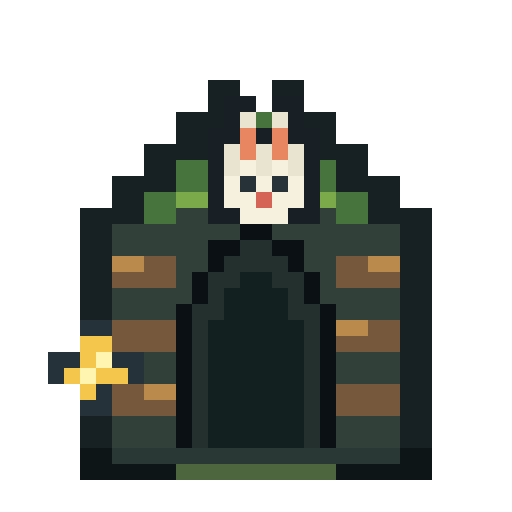
Costumes change gameplay
A Sephiria Costume can change starting items, stats, Dash behavior, MP, damage, inventory, or resource rules. That means it belongs in a build description alongside the weapon and core Artifacts. A route copied with a different Costume may not begin with the same resources or reproduce the same trigger cycle.
Costumes are selected in Bunnyville before starting the next adventure. The recorded database separates playable Costumes from appearance variants, which only change presentation. The 27 count applies to the playable mechanical choices in the captured v1.0.24 source.
Useful Costume groups
The archive becomes easier to scan when choices are grouped by the rule they alter. Elemental Magic covers fire, lightning, cold, or mixed elemental starts; Grimoire and MP covers spell resources and costs. Dash and Mobility affects movement, while Critical and Special Attack changes burst or alternate-attack assumptions.
Debuff and Risk-Reward choices exchange a drawback or condition for a payoff. Inventory and Economy affects space, items, or resource flow, while Artifact Companion themes begin around a particular Artifact relationship. These groups describe build roles, not official classes or a tier order.
| Group | Questions to ask |
|---|---|
| Elemental Magic | Does the starting rule provide the element or trigger the build needs? |
| Grimoire / MP | Can the run generate and spend MP consistently? |
| Dash / Mobility | Does the weapon benefit from more repositioning or Dash triggers? |
| Critical / Special | Is the route already built around those attacks? |
| Debuff / Risk-Reward | Can the player manage the drawback in ordinary rooms and bosses? |
| Inventory / Economy | Does the extra flexibility outweigh direct combat support? |
| Artifact Companion | Can the inventory support the companion’s trigger and adjacency? |
Recorded elemental and stat unlocks
The v1.0.24 notes associate Red-Clothed Cat with 50 Fire Damage and Frog with 50 Lightning Damage. Otter is associated with at least 175% Critical Damage, while Eagle is associated with Dash Count 8. These are useful goals for route planning only if the current unlock screen still shows the same condition.
Build specifically for the threshold being tested. An elemental unlock needs access to that element, a critical unlock needs the relevant stat route, and a Dash unlock needs movement choices. Trying to complete several unrelated goals in one run makes it harder to tell why the condition failed.
Recorded chapter and difficulty unlocks
Fairy of Fortune is associated with completing Chapter 4: Fragment. Scholar Lizard is associated with Hard Mode 20+. These conditions depend on progression state rather than a single inventory arrangement.
Check the current chapter and difficulty wording before starting. The chapter guide confirms six chapters officially but does not invent a complete name table where official public data is missing. A historical Costume condition should not be used to fill gaps in the official campaign list.
Recorded cumulative and single-run unlocks
Mole is tied to defeating 300 Moles cumulatively in the saved database. Skeleton is tied to losing 333 HP in one adventure, and Ghost to obtaining at least five Grimoires in one adventure. The distinction between cumulative and single-run goals determines how the attempt should be tracked.
Do not assume that damage prevented, temporary health, discarded Grimoires, or similar edge cases count unless the current client shows progress. A completion notification or changed selection entry is stronger evidence than reaching a number on the final screen without the unlock appearing.
Choose a Costume for a build
Start with the weapon’s main constraint. Greatsword may value room to recover, Crossbow needs safe firing and reload windows, Dagger needs access and exit, Katana manages state and MP, and Quarterstaff shapes space. Choose a Costume whose rule supports that constraint or enables the build’s trigger.
Then separate essential contribution from convenience. If the build only functions because of a Costume’s starting item or resource rule, state that explicitly. If the Costume only improves consistency, record a fallback for players who have not unlocked it.
Appearance variants and evidence
Appearance variants do not count as another playable Costume unless they also change mechanics in the current selection screen. Keeping visual and mechanical records separate prevents inflated character totals. It also helps players understand whether an unlock changes a build or only its look.
Every numeric condition on this page is labeled as a v1.0.24 community record. Current in-game text takes priority, and screenshots should include the version and full unlock panel. This site does not invent missing Costume names, effects, or thresholds.